The problem with rigid fingers
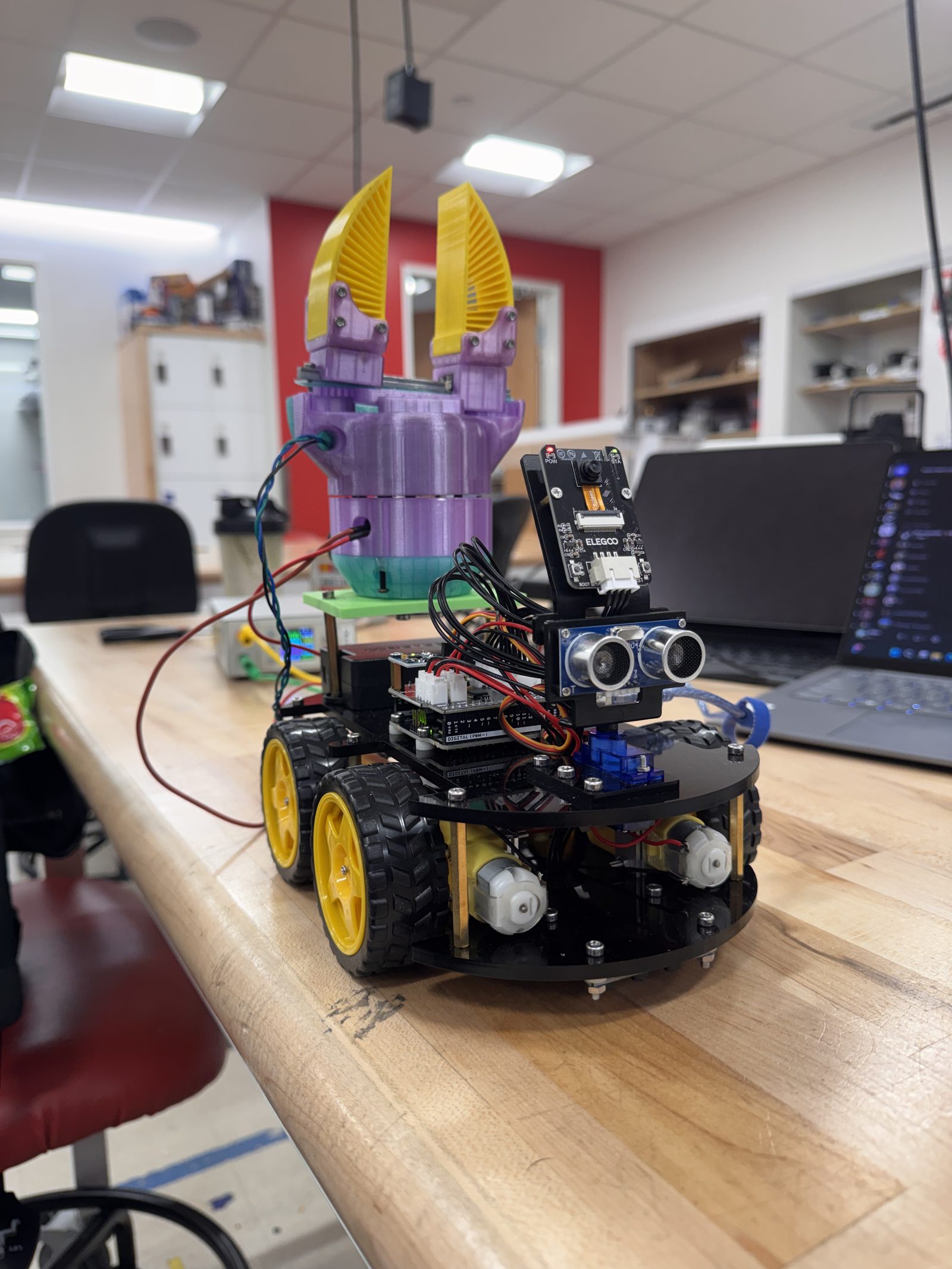
Most low-cost grippers pinch with two rigid jaws: fine for a block, unreliable for anything irregular, soft, or off-center. A fin-ray structure solves this passively: a triangulated lattice between two ribs that flexes and wraps around whatever it touches, distributing contact force instead of concentrating it at two points. The goal for this build was to pair that passive compliance with real, closed-loop actuation rather than a simple open-close servo.
Controller: moteus-c1 over CAN-FD
Actuation runs through a moteus-c1 r1.2 field-oriented controller driving an mjbots mj5208 motor over CAN-FD, chosen for the torque density and closed-loop position control it offers in a small footprint, the same class of controller used in quadruped robot leg actuators. Getting there wasn't clean: the driver stage threw repeated DRV8323 fault codes during bring-up, which traced back to a damaged motor that needed replacing, followed by a full ADC recalibration to get clean current sensing again before the controller would hold a stable position loop.
Half the mechatronics is the mechanism. The other half is convincing the driver IC it isn't broken.
Trigger pipeline
The gripper is commanded from a host machine rather than free-running: an Arduino handles the low-level trigger signal, and a Python script over USB serial (trigger.py) sequences open/close/hold commands so the grasp cycle can be scripted and repeated for testing. That separation made it possible to characterize grip behavior (approach speed, hold force, release timing) independently of the mechanical design, and to swap in new triggering logic without re-touching the firmware.
Documentation as part of the deliverable
The course required the build to stand on its own: an IEEE-format paper documenting the design and results, a full slide deck, STL renders of the final assembly, and an interactive HTML widget that visualizes the finger kinematics so a reviewer can see how the lattice deforms without needing the physical part in hand.